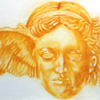

A Fairy-Tale, Her Secret Garden, A Nonsensical Vision
A Fairy-tale: She Enters Her Secret Garden
 This painting, A Fairy-tale: She Enters Her Secret Garden, A Nonsensical Vision, is a dream vision across time¹, a perspective rooted in my esoteric upbringing and practical experiences of magick and dream control. My early experiences with “Astral Projection are foundational to my understanding of other realms of reality.
Moreover, the painting acts as a waking dream, a state of consciousness that blurs the line between sleep and waking. He articulates this as the “conundrum of multidimensional dialogue” and “communicating with other-dimensional alien entities”, a theme that has occupied him since childhood. Consequently, a fairytale, in this sense, is a record of an astral journey, a communique from the spirit world.
I base the fairytale on my esoteric upbringing and lifelong experiences of magick and dream control. As a result, these early experiences with “Waking Dreams” shape how I understand other realms.
In my view, waking dreams are a technology of consciousness that blurs the line between sleep and waking. I articulate this through a “conundrum of multidimensional dialogue” and “communicating with other-dimensional alien entities”. In this sense, a fairytale is a record of an astral journey, a communique from the spirit world.
The Artistic Method: Materializing the Dream
My life’s work, both as a painter and an author, is an effort to develop techniques that “materialize the dreaming experience into the language of the waking world”. His art, he believes,, belongs to a “theater” of life, inviting viewers into “spheres of alternative consciousness”.
I perceive the creative process as an “externalization of the struggle to rationalize and give form to the unknown,” much like an oyster creating a pearl.
A Sacred Practice: The Fairy-tale as a Religion of Dream
I believe that instead of conventional religion, we should adopt a “repertoire with our Daemon. If we need a belief system, then let it be of our own creation. Let it be from the articulations of our Daemon”.
Additionally, this practice honors the daemon as primal psycho-pomp, where symbols replace scriptures and creation becomes spell. Moreover, a fairytale, as a waking dream, serves as a magickal spell capable of transforming the soul.
The Invitation to the Viewer to Enter The Secret Garden
This process is not passive. I compare it to a childhood technique of “staring at clouds and seeing recognizable images emerge from the perceived chaos”. By allowing a work to speak to “a deeper self than the superficial mind,” the viewer becomes part of the creative process, and the artwork evolves into a “dynamic and in constant flux” state.
Fairy tales weren’t always simple bedtime stories. Before they were softened and made safe for children, they existed in darker settings: deep woods, abandoned cabins, enchanted towers, with poisoned fruit, sinister deals, and strange transformations. The Brothers Grimm captured that older, more mysterious world. Their stories remind us that fairy tales were shaped by fear, warnings, toughness, and wonder. Children wandered into forests. Wolves talked like people. Witches hid behind gingerbread houses. Princesses were put under a spell into a deathlike sleep. Frogs turned into princes. Names held secret power, a remnant from ancient times. Apples tasted like death. On Fairy Day, we remember not just the pretty, magical aspects, but also the deep, often hidden roots of folklore—that twilight world where beauty and terror go hand in hand.
Summary
In essence, from my magickal perspective, a fairy-tale is a waking dream. It is a tool for “reintroducing mystery and ambiguity back into the adventure of human existence,” revitalizing the audience with impulses of their subconscious. It is a call to create your own reality, lest you “be condemned to live in someone else’s”.
Footnotes
¹ Time Lapse is a term describing how static artwork uses visual cues, such as blurred lines, repeating figures, etc to create an illusion of movement and the passage of time. It suggests a sequence of events or dynamic action.