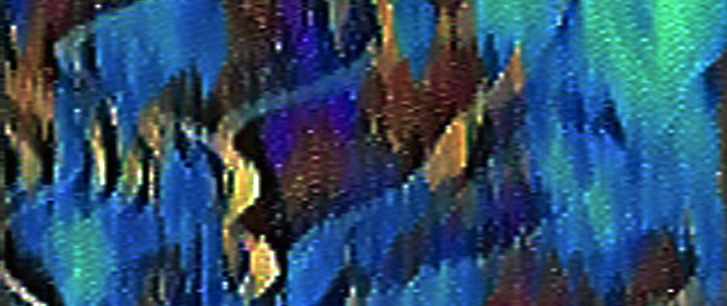
Alien Transmission, Dream Linguistics
Alien Transmission: Travelling in Spirit Vision, Astral Projection, Skrying and Communication with Other Worlds
Introduction
Do we, through the practice of astral projection, skrying, etc., become aware of Alien Transmission from either within or outside of ourselves?
Yes, I believe we do.
These other worlds, we interact with, appear to have a life of their own and their inhabitants appear to function independently of ourselves. Meaning, they are not just being projections of the user’s own mind. This is a quality frequently ascribed to our daemon¹.
From personal experience, my argument is that the vision isn’t invented. It is better described as being caught. We might also consider that a melody isn’t composed. It is dictated. The being in the tattwa symbol² or scrying mirror isn’t projected. It is translated from a language of pure presence into two, or maybe more, multi-dimensional images, sounds, or words.
Dream Linguistics
Dream Linguistics is a language born from synthesis. It is a title I use to rationalise and coagulate the diverse information and symbolic language that we receive through inter-dimensional communications³.
Founded upon the theory of correspondences, as illustrated in the QBL, it encourages us to perceive and translate phenomena and experiences through a window of kaleidoscopic vision and or mathematics. Mathematics is a more universal and less ambiguous language.
Translation always loses something and or is coloured by the translator’s own life experiences, but it also reveals something. The original transmission is alien; it is not a human language. Its characters can be pheromones, colour, pressure, silence, or a pattern that weaves through multiple dimensions. All of which are spectrums of vibration. Dream Linguistics, through the medium of art, is the best imperfect rendering.
So the question is no longer “What did you create?” but “How clear was the signal and how faithful your rendering?”
The most popular approach to explain this phenomenon has been to explore the middle ground offered by Jungian psychology, specifically archetypes and the collective unconscious. This model endeavours to explain why figures in dreams or visions can appear to act independently. However, this model ignores the possibility of these experiences originating from outside of ourselves. Jung’s theories are focused upon the functions of our receiver, i.e., our brain, and not transmissions originating from outside of ourselves.
The Dream Linguistics model in no way references Jung, except to use his theories as a backdrop to illustrate Dream Linguistics differences in philosophy.
The theory is a form of ontological pluralism, multiple worlds, multiple agencies, all real.
Experiences, perceived through astral projection, lucid dreaming, etc., are translated through our daemon¼. Communication moves from astral interaction through art, as translation, through our daemon as receiver, so we develop self-trust. If the daemon translates transmissions, and art renders them, then trusting oneself means trusting one’s own daemon, one’s own translation process, one’s own possibly imperfect, but authentic reception.
The World as Objective Non-Physical Reality
This point of view argues that there are real, distinct planes of existence, etheric, astral, mental, etc.
Why do they seem independent? Because they are independent.
These diverse inhabitants, such as nature spirits, elementals, ghosts, astral parasites, and guides, have their own lives, goals, and histories. Just like your daemon. However, they do not necessarily care about your psychological integration.
The Danger and Opportunity
You are a visitor in a foreign country. You must learn its laws and etiquette. Interaction is a real interspecies or inter-dimensional diplomacy. Their autonomy is absolute and can be hostile, indifferent, or helpful.
To expand on these theories, we should do well to take a look at the oldest and most direct framework. Shamanism.
Here reality is populated by many kinds of entities, human, animal, plant, stone, land, weather and also spirit persons. These spirits have their own cultures, territories, and intentions.
How do these entities enter our world: Through our objective performance of Magickal Machines, or through thresholds, images seen in clouds, crossroads, caves, mirrors, altered states, trance, dreaming, or cracks in consensus reality as a result of trauma, ritual, and or psychedelics. The Magician and shaman’s function is to manage these crossings through negotiation or banishing.
These entities do not arise from your psyche. However, that is not to say you might attract them, but you do not create them. As an example, a land spirit was there long before you were born.
If you don’t create your own reality, you are condemned to live in someone else’s.
Conclusion: The Unified Code – Dream Linguistics, Gematria, and the Tarot
What Dream Linguistics offers is a framework for translation: a way to receive the alien transmission, whether from a tattwa symbol, a scrying mirror, or a land spirit, and render it into human terms. But a framework alone, however elegant, risks remaining poetic intuition without a method for verification or deep pattern recognition. This is where the principles of Kabbalistic gematria and the symbolic architecture of Tarot enter the mix, not as overlays, but as precision tools embedded within Dream Linguistics itself.
Gematria, the practice of assigning numerical values to letters and seeking connections between words of equal sum, transforms the act of translation from subjective rendering into a multidimensional decoding. The alien transmission arrives as a spectrum of frequencies: colour, pressure, pheromone, silence. Gematria adds numbers to that spectrum. And number, as noted, is a more universal and less ambiguous language.
Tarot contributes a complementary, visual-numerical lexicon. A Tarot card is not merely an image; it is a dynamic pictograph. Each card encodes a specific configuration of correspondences: astrological, elemental, numerical, and archetypal. The 22 Major Arcana tarot cards correspond with the 22 letters of the Hebrew alphabet, directly linking Tarot to gematria and the QBL. The four suits correspond to the four classical elements: Wands = Fire, Cups = Water, Swords = Air, Pentacles = Earth. The numbers 1 through 10 on the minor arcana cards follow the same Pythagorean and Kabbalistic number philosophy that gematria explores.
In short, Tarot is a portable dictionary of the very language Dream Linguistics seeks to translate.
Tarot also serves as a scrying tool in its own right, a magickal machine for crossing thresholds. The cards themselves are thresholds: images seen in a spread can serve as cracks in consensus reality, allowing spirit entities to speak through the arrangement. A shaman reads bones; a magician reads Tarot. Both are negotiating with autonomous agencies. When you lay out a spread, and the cards seem to “jump” or invert in ways that feel independent of randomness, you are experiencing the same phenomenon as the astral traveller meeting a land spirit. The difference is the medium. Thus, Dream Linguistics, gematria, and Tarot form a triadic engine for translation.
- Dream Linguistics provides the philosophical framework: translation of alien frequencies into human art.
- Gematria provides the numerical grammar: a universal, testable code beneath language.
- Tarot provides the visual-lexical interface: a ready-made set of dynamic pictographs that bridge the alien and the familiar.
Together, they answer the opening question with greater precision. Do we become aware of worlds either within or outside ourselves? Yes. We can now map those worlds through numbers, images, and correspondence. The vision is not invented; it is caught. The melody is dictated. And the Tarot card you draw, the gematria you calculate, and the dream-image you paint are all renderings of the same transmission, filtered through your daemon, anchored by mathematics, and illustrated by archetypes that have served travellers for centuries.
This synthesis does not replace trust in your daemon. Rather, it gives your daemon a grammar, a lexicon, and a map. Where pure intuition might be swayed by mood or expectation, gematria offers a fixed point: the sum is the sum. Where a vision might blur, Tarot offers a second witness: the card’s traditional meaning alongside your intuitive reading. The interpretation remains personal, artistic, and authentic, but it is no longer adrift.
Ultimately, this returns us to my final line: If you don’t create your own reality, you are condemned to live in someone else’s. By adding gematria and Tarot to Dream Linguistics, you are not creating reality. You are decoding the reality that already exists, the objective, non-physical worlds you travel through.
The question evolves from “How faithful was your rendering?” to “How deep does the code run?” And the answer, discovered through practice, is this: deep enough that the numbers sing, the cards speak, and the images breathe. That is self-empowerment. That is the unified language of consciousness.
Footnotes
¹ In Western Ceremonial Magick jargon, this is called one’s Holy Guardian Angel.
² From experience, I have found tattwa symbols to be
³ See Dream Linguistics Dream Language. https://rogerwilliamsonart.com/dream-linguistics/
¼ Art brings something new into existence, a vision, a sound, a something that wasn’t there before. Science comes after, attempting to discover what art has already done, often missing the point entirely.
Diagrams
- Tattwa Symbols
Suggested Reading
King, Francis. (1979). Ritual Magic in England. Neville Spearman.
Lessing, Doris. (1979), Shikasta. Jonathan Cape.
Linden, Mishlen. (1991). Typhonian Teratomas. Black Moon Publishing.
Williamson, Roger. (2004). Lucifer Diaries. Metatron Books.
Suggested Movies
Arrival, 2016
Angel Heart, 1987
Appendix
Communication with the daemon has certain parallels with a schizophrenic state; as such, we use the term ‘quasi-schizotypal’ to describe the state of mind in question. The modern understanding of this condition tra
ces its origins to the late 1500s, when it was known as self-talk. In her work “Invisible Guests,” Mary Watkins discusses the implications of self-talk, relating them to the theories outlined by Julian Jaynes in his monumental work on bicameral mind theory, The Origin of Consciousness in the Breakdown of the Bicameral Mind
When interacting with the daemon, it is crucial to recognise that it is not merely a shadow or mirror image of our waking self. Instead, it should be understood as an entity in its own right, a twin, “an other”, that shares a common root with what we perceive as ourselves. Similar to our waking self, it is a being with its own desires, ambitions, focus, and existence.
The relationship between our conscious self and our daemon
This should be that of an electron’s relationship with itself and its nucleus.
Attraction
You, the nucleus, are the centre, structure, identity, and gravity. You and your daemon, electron, are bound by an unbreakable relationship. Separation means ceasing to be one system.
Repulsion
The daemon never collapses into you. That distance, autonomy, mystery, and otherness create consciousness. The friction between what you know and what you can’t control sparks thought, intuition, conscience.
Stable Orbit
Too much attraction and the daemon is swallowed by your ego, or more likely, your ego by the daemon
Too much repulsion and the daemon is torn away to become dissociated, haunted, and an enemy.
When balanced, you are the heavy centre and your daemon is the fast periphery. Polarity influence without merging.
There is no fixed path; there is only a probability cloud. You’ll never know exactly where your daemon is or how it will respond. But over time, you can come to know its temperament and patterns.
Warning
If you become obsessed and try to over-analyse it, you will force it into logical boxes; you kill its living nature, and it becomes a dead object.
Relationship
You are not your daemon, but you are not fully you without it. A complete system held together by tension: repelling enough to stay distinct, attracting enough to stay whole. A relationship, not a union.
An Alternative View
We should also do well to consider the possibility that what we refer to as our daemon may not be a part of ourselves. It could be an external alien force perceiving us to be nothing more than slave or drone tools functioning to their commands for the furtherance of their own agenda, such as life extension.
This perspective raises theories of vampirism, a concept explored in length by Bram Stoker in his novel, Dracula.