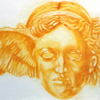

The Odyssey of the Daemon
The Odyssey of the Daemon: Magick, Mind, and the Quest for Wholeness

I. The Core Thesis: The Odyssey as Daemonic Quest
Homer’s The Odyssey is far more than an epic poem; it is a universal allegory for the search for our Daemon, our essential spirit, true Self, or guiding genius.
In this journey:
- Penelope, Odysseus’s wife, represents the externalised image of his daemon. She is the symbol of his wholeness, his kingdom, and his completed self. The unwavering goal that guides his entire path.
- The Odyssey itself is the “magical mythical path” of trials, purification, and transformation required to unite with this daemon. It is the process of individuation, where the wandering ego, Odysseus, must overcome its monsters. This is so he can integrate its shadows to become worthy of sacred reunion.
II. The Soulmate as the Daemon’s Mirror
This quest extends into our most intimate relationships. The person we are attracted to as a “soulmate” is, in truth, a powerful projection of our internal daemon. This explains the magnetic, fated quality of such connections. However, the ultimate purpose is not merely to find the other, but to use the relationship as a catalyst for growth. The real goal is to withdraw the projection and integrate the daemonic qualities we admire in the other into ourselves, thus achieving our own wholeness.
III. The Magickal Praxis: Conversing with the Daemon
The philosophical and relational journey finds its most active expression in magickal practice. A primary objective of practising magickal techniques is to move beyond metaphor. It is to actively establish contact and engage in conversation with your daemon.
- Magick as Daemonic Interaction: From this perspective, all magick can be conceptualised as depending on, and ultimately taking place in conjunction with, the Daemon. The daemon is the inner source of power, knowledge, and authority. Rituals, invocations, and meditations are technologies for tuning the consciousness to this internal frequency, facilitating a collaborative partnership between the ego and the deeper Self.
IV. The Ontology of the Daemon: An “Other” Within
When contact is established, a crucial realisation dawns: the daemon is not merely a shadow or a mirror image of our waking self. It should be understood as an entity in its own right, a twin, “an other”, that shares a common root with what we perceive as ourselves.
- Autonomy and Lineage: The daemon has its own motivations, desires, and perspectives. It speaks, advises, and sometimes contradicts the ego. This autonomy raises the profound possibility that the daemon is the culmination of all our previous incarnations, a coalesced intelligence formed across multiple lifetimes, now serving as a guide for the current incarnation.
- The “Quasi-Schizotypal” State: Engaging in dialogue with this autonomous inner voice has clear parallels to a schizophrenic state. However, in a magickal context, this is a voluntary, curated, and integrated phenomenon. We use the term ‘quasi-schizotypal’ to describe this specific state of mind, where the boundaries of the ego are softened to allow for conscious communication with another centre of consciousness within the psyche.
- Historical and Psychological Context: This phenomenon is not a new development. Its modern understanding traces its origins to the late 1500s, where it was known as self-talk or “invisible guests.” In her work Invisible Guests, Mary Watkins explores this territory, relating it to the theories of Julian Jaynes. In his bicameral mind theory, Jaynes proposed that ancient humans experienced their inner directives as the voices of gods. This is a state analogous to the modern magician consciously engaging with the voice of their daemon.
Conclusion: The Unified Journey
The path is now complete:
- The Call: We feel an innate yearning for wholeness, symbolised by the quest for home or a soulmate.
- The Practice: We engage in magickal techniques to make contact with the source of that wholeness—the daemon—learning to interact with it as a distinct, intelligent partner.
- The Integration: We undertake our personal odyssey, guided by the daemon to navigate life’s trials. We learn to see our “soulmates” not as ends in themselves, but as mirrors reflecting the daemonic qualities we must embody.
The ultimate goal is the Hieros Gamos, the sacred marriage: no longer a mere reunion of Odysseus and Penelope, but the conscious, collaborative, and lasting union between the ego and the Daemon, culminating in the fully realised Self.
The original painting of Odyssey, oil on canvas, 72 inches x 36 inches, 2008 refinished 2011 is available from Saatchi Art
Fine art prints of Odyssey are available from Saatchi Art